
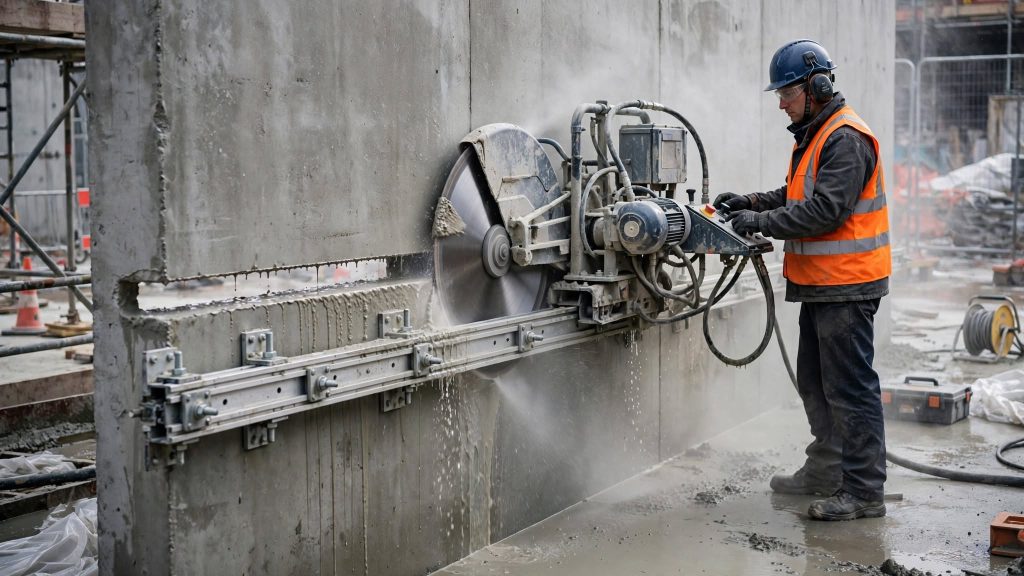
Creating a new doorway, window, service opening, or access point in an existing concrete structure requires more than simply breaking through the material. The opening usually needs accurate dimensions, clean edges, and careful control over the surrounding concrete. Wall sawing is a concrete cutting method designed for this type of work.
Using specialized saws fitted with diamond blades, contractors can make controlled cuts through concrete walls and other vertical surfaces. This approach is commonly considered when renovation, utility installation, structural modification, or building upgrades require a precisely defined opening.
What Is Wall Sawing?
Wall sawing is a method of cutting concrete, reinforced concrete, masonry, and similar construction materials. A wall saw typically operates along a track secured to the cutting surface. The track guides the saw in a straight, controlled path while the blade cuts through the material.
Unlike demolition methods that rely primarily on impact force, wall sawing removes material along planned cut lines. This makes it useful when the shape, size, and position of an opening matter.
The process can be used for vertical cuts as well as certain angled or horizontal applications, depending on the equipment, structure, and site conditions.
How Wall Sawing Produces Accurate Concrete Openings
Precision begins before the blade touches the concrete. The location and dimensions of the required opening must first be established. Contractors also need to consider what may be inside or behind the wall, including reinforcing steel, electrical lines, plumbing, and other building services.
Track-Guided Cutting
One of the main features of wall sawing is its track-guided operation. After the cutting lines are marked, a track is mounted to the surface. The saw travels along this track rather than depending entirely on manual guidance.
This setup helps maintain straight cuts and makes it easier to follow the dimensions specified for the opening. It is particularly useful for rectangular openings such as doors, windows, ventilation penetrations, and equipment access points.
Diamond Blade Cutting
Wall saws generally use diamond blades capable of cutting dense construction materials. Depending on the project, the blade may need to pass through both concrete and embedded reinforcement.
Water is often used during cutting to cool the blade and help control concrete dust. However, the exact cutting setup depends on the equipment and conditions at the work area.
Where Wall Sawing Is Commonly Used
Wall sawing can support many types of construction and renovation work. A commercial building may require a new doorway between two areas. A basement renovation might involve adding a window opening to an existing concrete wall. Industrial facilities may need larger penetrations for ducts, machinery, pipes, or building services.
The method can also be useful during remodeling projects where an existing opening needs to be enlarged or repositioned.
Not every concrete penetration requires wall sawing. Smaller circular openings for pipes, cables, conduits, or mechanical services may instead be created through core drilling. For a closer look at that method and where it is appropriate, Core Drilling Guide: Uses, Benefits, and What to Expect Before You Start explains the process and its typical applications.
Why Precision Matters When Cutting Concrete
An inaccurate concrete opening can create additional work. If a doorway is cut too small, further cutting may be necessary. If it is oversized or uneven, additional finishing or structural work could be required before the frame or component can be installed.
Clean, controlled cuts also make later construction stages easier. Door frames, windows, ventilation systems, and other components depend on openings that match their required dimensions.
Wall sawing therefore helps connect the concrete cutting stage with the installation work that follows.
Planning Before Wall Sawing Begins
Successful wall sawing depends heavily on preparation. Concrete walls can contain reinforcement and concealed building services, while some walls may have structural functions that must be considered before modifications are made.
Before cutting starts, the project team may need to review drawings, confirm measurements, identify utilities, assess access, and determine how the cut section will be handled.
Managing the Removed Concrete
A wall opening does not disappear once its perimeter has been cut. The separated concrete section may be extremely heavy, particularly when the wall is thick or the opening is large.
A removal plan should therefore be established before the final cuts are completed. Depending on the project, the concrete may be divided into smaller sections or handled using suitable lifting and material-handling equipment.
Planning this stage helps prevent the cut section from becoming an unexpected obstacle once it is detached.
Wall Sawing Compared With Impact Demolition
Traditional demolition tools can be appropriate when concrete simply needs to be removed and precise edges are not important. Wall sawing serves a different purpose.
Instead of repeatedly striking the concrete, the saw follows predetermined cutting lines. This gives the project team greater control over where material is separated from the remaining structure.
The distinction becomes important in occupied buildings, renovation projects, and areas where surrounding surfaces need to remain intact. Wall sawing still requires careful site management, but it provides a more defined approach than uncontrolled concrete removal.
Practical Limitations to Consider
Wall sawing is not automatically suitable for every concrete modification. Equipment access, wall thickness, reinforcement, available power or water, nearby utilities, and the structural role of the wall can all affect how the work should be approached.
The area on the opposite side of the wall also matters. Contractors need enough control over the work zone to manage the blade path, slurry or debris, and the concrete section being removed.
Structural changes may require professional review before cutting begins, particularly when an opening affects a load-bearing element or other important part of the building.
Conclusion
Wall sawing provides a controlled way to create accurately positioned openings in concrete walls. Its track-guided cutting system and diamond blade allow contractors to follow defined lines for doors, windows, ventilation routes, utility access, and other building modifications.
The quality of the finished opening depends on more than the saw itself. Accurate measurements, awareness of reinforcement and utilities, safe handling of removed concrete, and proper planning all play important roles. When the method suits the structure and project requirements, wall sawing can make concrete modifications more precise and easier to integrate with the construction work that follows.